
There are only a few days left in this year.
This will be held over six days from the 21st to the 26th, right in the middle of Christmas.
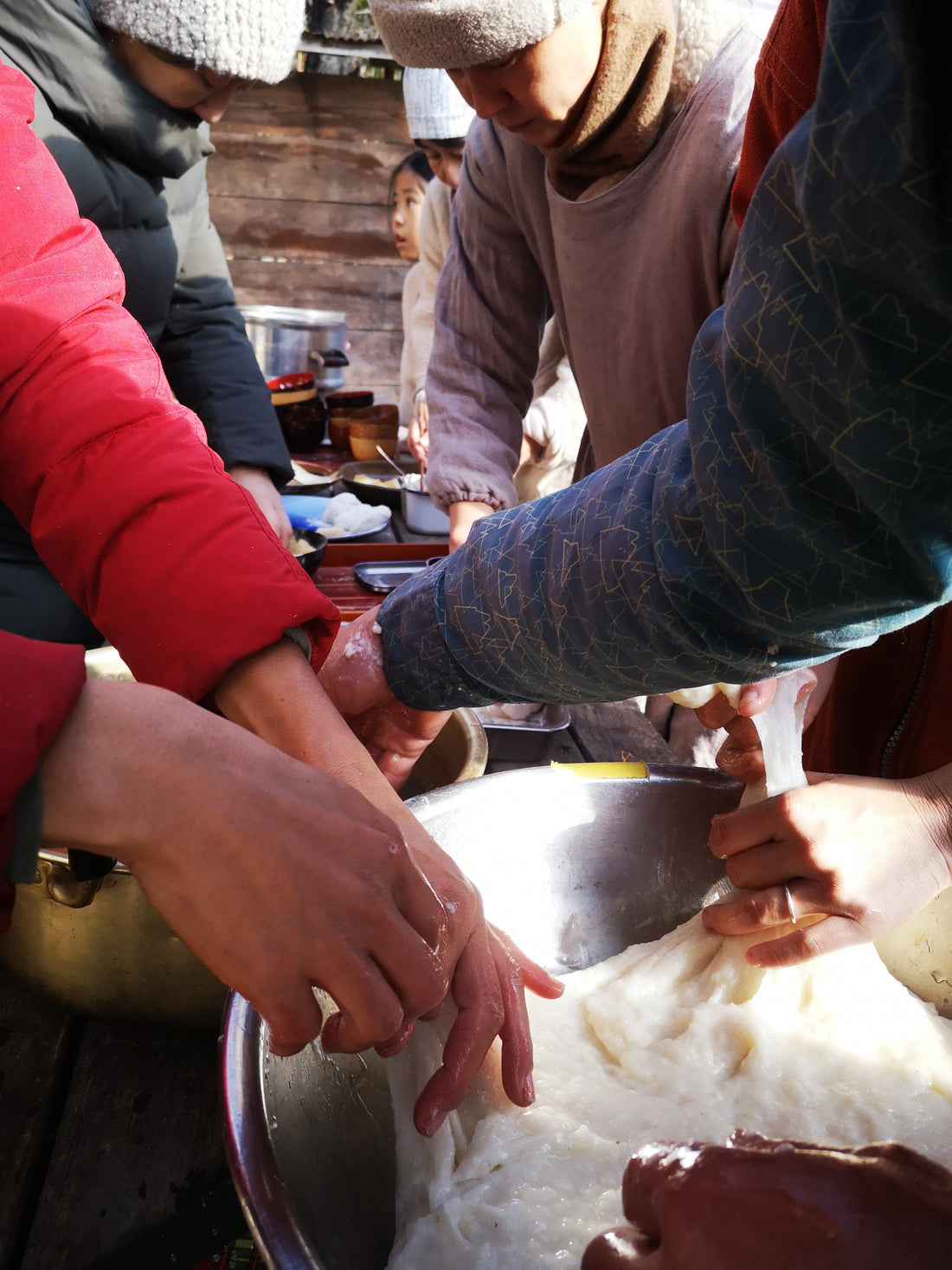
The last big job of the year was making rice cakes.

The mochi-pounding began on the preparation day, the 21st, when the rice was washed and soaked, and the tools were prepared.
From the 22nd to the 24th, we spent three days pounding 170 kg of rice cakes in a total of 28 mortars.

The glutinous rice we use is "Kokonoemochi," which is grown with great care in our own rice fields and dried in the sun without the use of pesticides. We put it in a kamado (traditional Japanese cooking stove) and steam it slowly over a wood fire, then pound it in a stone mill to make mochi. This process is all done by hand, requiring a lot of manpower.

I asked around and many people came to help me. They also cooked lunch for us all to eat.
 Instead of giving money as thanks for their help, we gave them lots of rice cakes. We are truly grateful to everyone who willingly comes to help every year.

This mochi project is a joint project between Amedoto and his friends from their days at Pitara Farm, Kosugi-kun from OKOME CRAFT and Tasai-kun from Kurashibata. Since the change to Pitara Village, each of them has been operating under their own business and trade name, but for the annual mochi pounding event, the three of them join forces and work together on growing the glutinous rice.
It is very comforting to be able to cooperate with other farmers while maintaining a loose connection with each other, and I hope that the circle of mutual help will continue to expand through mochi making.


Year-end special vegetable set
We have gathered vegetables that are perfect for the New Year. Please bear with us as we tell you about the wishful thinking behind each vegetable.
|
Japanese white radish Daikon radishes, which have long, thick roots that spread underground, are used in New Year's dishes, such as ozoni, daikon sushi, and onamasu, with the hope that the plant will prosper for a long time. |
taro Because potatoes are connected like a family tree, from parent potato to baby potato, grandchild potato, and great-grandchild potato, they are eaten in hopes of "prosperity of descendants." They are an essential ingredient in simmered dishes. |


|
carrot Ni "n" ji "n" has two "n"s, so it is said to be a wish for good luck. It is used in ozoni, simmered dishes, and onamasu. |
Burdock Burdock is considered a symbol of longevity because it has long roots. It can be used in pounded burdock or Yawatamaki. You can also enjoy its aroma by adding it to simmered dishes. Eating burdock in the cold season will help you stay healthy. |


|
Nagaimo We specially purchased Nagaimo (Japanese yam) from DORO, a nearby organic farm specializing in root vegetables. Nagaimo is a vegetable that protects the body during the cold, dry winter. We recommend pickling it in wasabi and dashi stock for the New Year's feast. It's also delicious when simmered. |
green onion The summer heat was intense, and the leeks didn't grow very well, but they are small, so they are perfect for cutting into small pieces! Use them as a condiment for New Year's Eve soba noodles, etc. |

|
Turnip The white of the turnip is a sacred color. Kikuka turnips are made by cutting them into the shape of a chrysanthemum, which is said to ward off evil spirits, and then pickling them in sweet vinegar, making them a staple New Year's dish. They are also delicious when sliced thick and roasted. They are also delicious when thinly sliced and seasoned with salt. |
spinach The greens used in ozoni vary greatly depending on the region. Edo uses komatsuna, Kyoto uses uguisuna, and Nara uses mana, and each uses the best leafy vegetable in that area. Here in Hokuto City, the sweetness of spinach is maximized. Please give it a try. |


